Thoughts on the Superbowl


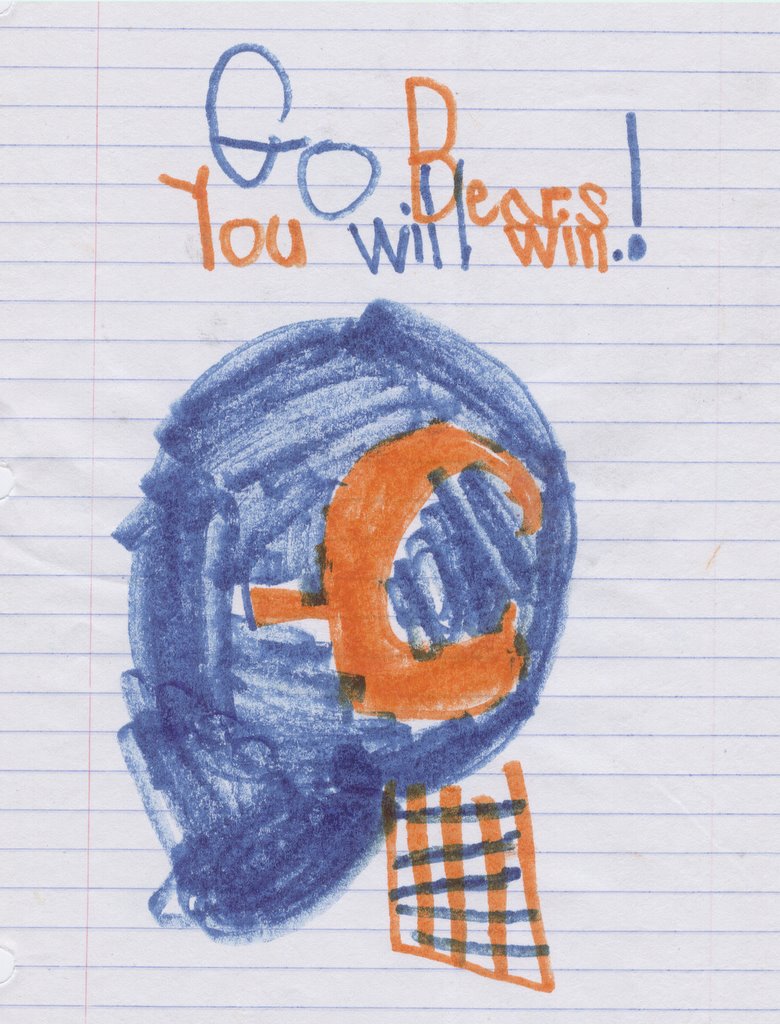
The drawing above of a Bears helmet was done by an outsanding 7 year old boy currently in first grade, my son.

If I were a sports fan, in theory, I would be torn about the upcoming game between the Colts and the Bears. I dedicated almost eight years of my life to the Jewish community of Indianapolis. I, now, currently reside in Chicago. For me, it really doesn’t matter who wins… I’ve never been too into sports.

For my son, well, it’s a different story altogether. His love of the Bears has grown over the past year. He has ‘subliminally’ been showing his team pride over the past few weeks with his drawings and colorings of the weekly parsha. First it was Yosef’s me’il that was colored blue and orange. Then it was a Bears blanket that covered Paro as he slept and dreamed. Most recently it was a picture of two Jewish slaves working in Egypt, wearing Bears jerseys.

As I said, I’ve never been too into sports. But I keep up with the scores, watch some of the games with him (and let him explain things to me) and try to bond with him. It’s important to show interest in what our kids are interested in. My neighbor is a huge Chicago sports fan (Sox not Cubs). I have observed the special bond he has with his oldest child when it comes to sports. I know that I cannot make myself into a sports fanatic, but I try to use things like “da Bears” as a way of bonding with my son. My son is wise to me. He knows that I’m not as into it as other dads, but he’s cool with it. He sees that I make the effort and I hope there is something to be said for that.

An observation: In a city devided by baseball like Chicago it’s nice to see people rally behind one common goal…the Bears. There is a lot that I take away from such unity, even on a gachmius level.

Note: I do enjoy watching the XGames!

A moment of reflection

There was a time when I couldn’t imagine not posting for over two weeks. It’s not that my life is so exciting or that I have so much to say, it’s just that I had a lack of free will when it came to blogs. Things have changed for the better.

I didn’t start out planning not to post, but things came up like family, rubber bands, work, and freezing cold temps in our playroom/computer room.

During my ‘break’ from posting two things transpired. Firstly, as of the beginning of January, I have posted more than 100 times on blogger. For me, as someone who enjoys writing, but hadn’t kept up with it in years, this is a milestone. I look at it as over 100 journal entries!

The second thing that happened was much more humbling. My sitemeter went over 10000. I am blow away that my little blog has been viewed more that 10000 times. I was floored when my first posting even got any comments.
Thanks to all of those who take time from their day to read and comment. It means something to me. On with the postings…

Expanding Rubber Bands

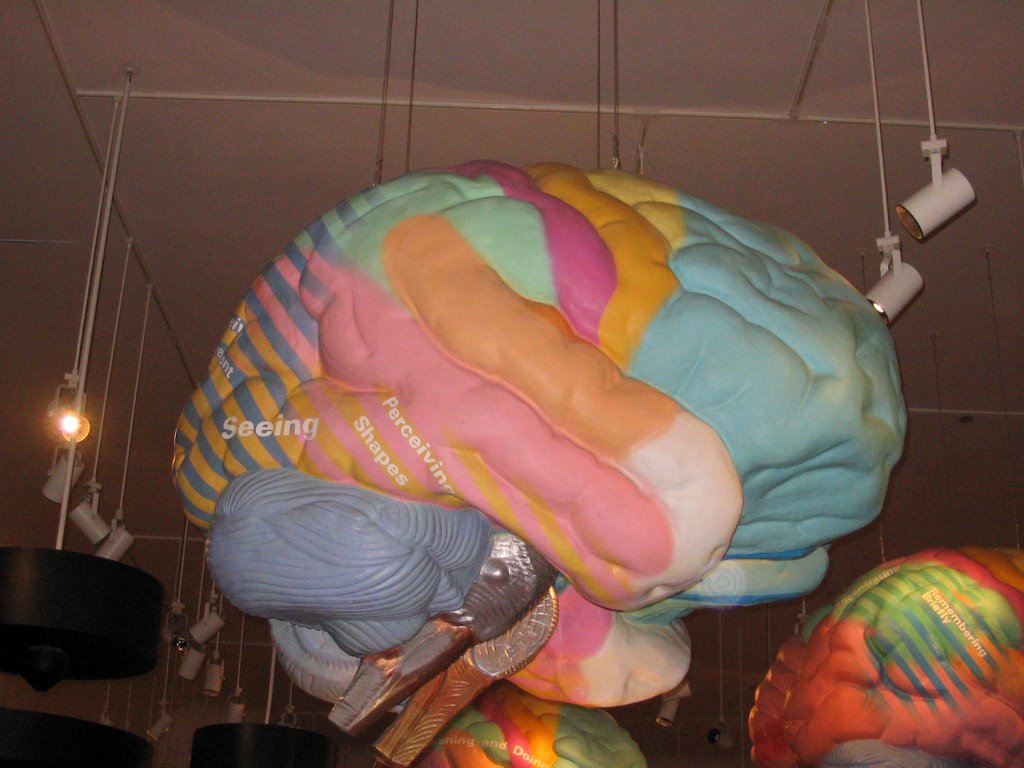
(Picture taken at the Museum of Science
and Industry in Chicago on 12/24/06)
In my previous post, , A Simple Jew commented: Have you found a positive action to replace the “negative” action of checking your e-mail so often?
The most obvious result of “Rubber Band Mussar”, in my case, is a more focused day in the workplace, more quality time with my family, more time to open a sefer, and an understanding of the difference between what I want and what I need. These, in and of themselves, are positive actions, however they are secondary.

The most obvious positive action is ….Awareness.
I’ve quoted this
before, but in second chapter of Mesillas Yesharim it states that:
THE IDEA OF WATCHFULNESS is for a man to exercise caution in his actions and his undertakings; that is, to deliberate and watch over his actions and his accustomed ways to determine whether or not they are good, so as not to abandon his soul to the danger of destruction, God forbid, and not to walk according to the promptings of habit as a blind man in pitch darkness.
No one wants to be a robot (although the life size Robbie the Robot pictured above was pretty cool), or a slave to habit. I sure don’t! The awareness of my addiction to checking email has, ironically, helped to stop me from acting robotic and doing things simply by rote. However, it’s more that just being aware of the choice I make to go or not go online. It’s a learning process and I am becoming much more aware of my behavior in general. It’s not so easy.
Example:
Last week my wife asked me to go bring in some milk from the car. I “stopped for a second” to check my email on the way and found myself sitting at the computer for 15 minutes. It was 32 degrees outside and the milk was fine, but that’s not the point. My wife asked me to do a simple thing and I let myself get distracted. That’s the point. I should not have touched the computer when I had something else to do. I could have used a rubber band then (of course now everyone at home is ready to shoot rubber bands at me thanks to my new mussar exercise). Things that so natural are the things that I often don’t make conscious decisions about.
With that being said, after being Torah observant for 19 years, I find myself doing some things by rote and it bothers me. I try to keep myself in check most of the time, but an automated Shemona Esray here, the conditioned response of an “amen” there, a half-hearted “Gut Shabbos” to a stranger just to be yotzai for saying “Gut Shabbos”, well…it adds up. It’s something I’m not true happy with, but at least I’m aware of it. I find myself these days being much more careful before I speak and aware of how best to use my time.
Like I wrote, no one wants to be robot. Not when I come to email (and the urge to read email is totally in full force after a posting goes up) and certainly not when it come to my Avodas Hashem.
Mediocrity is my enemy. Becoming comfortable with my Yiddishkeit not only pushes me away from Hashem, but from a chinuch aspect, it’s like the black plauge. Our children pick up on everything we do (I’ll write more about this in a future post). I remember listening to the lady at the post office say that her mother mumbled the blessings on Chanukah, and thinking that this is not how I want my children to remember their childhood and our Torah observant way of life.
As mentioned before, I have found myself become much more aware of everything I do. I find myself questioning if it’s “what I really need to do right now” and thinking about my actions. I recall certain thoughts and feelling I had when I decided start wearing a yarmulka in public. How careful I was about my manner of speech and behavior. Sometimes I feel that I have become too comfortable with who I am and my yiddishkeit, and it worries me.
When I wrote my previous post I really didn’t think that this rubberband thing would end up making me really examine my actions so much. I’m happy that I’m able to grow from my blogging, and in this case, with the help of several comments.
Last night I heard something that really made me angry. Well, at least I was aware that I could have become angry. Without missing a beat, I stuck my hand in my pocket and felt my trusty rubber band. Later my wife commented that she was actually surprised that I wasn’t more upset. Awareness of my actions saved me from losing my cool, this time.
Yet again, later that night, I went to check my email and realized that I stayed online longer that I needed to. Each opportunity is a challenge and a battle, but that’s alright. I fight, fall, and get up again.
Over the past few months (especially in the summer) I’ve felt that my ‘hobbie’ of blogging and reading other blogs has taken up a major amount of my time. I can say now, since I’ve become more mindful of the little things I do, I feel a new found sense of freedom about my hobbie. It’s important to realize what I am a slave to.

Stretching my own Bechira Point

(from yotophoto.com)

I have a tendancy (read urge) to check my email constantly. This is a major problem for me because it takes away time from other things I should be doing. I’ve tried only checking it at designated time, but I often slip up. It’s been driving me crazy, because I have no problem not eating any dairy for several hours after I’ve eaten meat. I have no urge to turn on light during Shabbos. Yet, I’ve struggled to not go online and check email for periods of a few hours. My Yetzer gets the bets of me.

Over the past few weeks, though, I’ve been slowly working on this. It has resulted in less time spent online (which is not a bad thing) and has been a good exercise in adjusting my own bechira point. At age 36, I have found myself, again, changing aspects of my behavior, I’m proud to write (it should be chizuk to anyone who needs it to change even the most mudane aspect of their personality).

For me things like going online (and other actions that are potenial unproductive and suck away my time from right under my nose) are really ‘pareve’ issues that I often fool myself into thinking don’t matter much and don’t require that much bechira to begin with. This is not the right way to think. I admit that I need to work on this.

The method I’ve been using was based on something I read a few years ago in Alan Morinis’ book Climbing Jacob’s Ladder. The book tells the true story of a man who grew up non-observant and his journey towards self-discovery that takes him to Rabbi Yechiel Yitzchok Perr, Rosh Yehsiva of Yeshiva of Far Rockaway, the tradition of mussar, and towards a Torah observant life.

Mr. Morinis writes (page 47) that after his initial meeting with Rav Perr he asked the Rosh Yeshiva for a mussar practice to work on. Rabbi Perr said “Well, what you can do is get a rubber band that’s big enough to fit around the palm of your hand. Keep it in your pocket, and when you feel impatient or angry, slip it on. No need to do anything more, just put it on.”
I decided to use this technique to me more aware of when I felt the urge to go check my email. It hasn’t been easy. It has help me become much more conscious of the choices I make. Not just checking email, but how I speak to others and being patient.
I’ve been keeping a chart of my progress and tracking the times that I’ve wanted to check email. Here’s last weeks:
Monday: No work
Tuesday: 9.:25, 10:04, 3:28
Wednesday: 11:36, 2:31
Thursday: 10:18 (no rubberband, 3:47 (no rubberband)
Friday: 11:45 (no rubber band)

On Tuesday and Wednesday last week I put on the rubber band. As you can see, by Thursday, I felt that I didn’t need it. It just sat in my pocket. It’s a great feeling knowing that I can change.

Pareve Coke Blak à la Uberdox


I admit, I like Coke Blak (or as I call it among my friends ‘Coke BlakHat’). I tried it right when I got the “ok” from the cRc and the OU. I actually was the first to ask the cRc about it. One problem…it’s dairy.

This make it difficult for someone who eats/drinks Cholov Yisroel to enjoy this great drink.
This wasn’t an issue for me Shavuos night, as we ate dairy. The extra jolt really helped during my night of learning.

But I’ve often thought how much I’d enjoy Coke Blak with my chulent on Shabbos (or even in the chulent for a turbo charged treat).

I’ve found that taking a 12 oz can of Coke and adding an 1-2oz of black coffee give you about the same taste. And you can enjoy it with fleishigs!

Results of my "Question to JBloggers"

Pic taken at the Museum of Science and Industry
in Chicago on 12/24/06

Thanks for all the comments. As pointed out, my ‘age posting’ was the most commented posting in Modern Uberdox history. Well, the average age of my readers is 38.4 years old. I really am surprised that it’s so close to my own age (36). With that being said, the results were not what I expected.
Originally I had hoped that my blog survey would highlight blogs as a kind of a bridge between generations of Jews. In theory, this was a nice idea. It would have added another positive aspect of Jblogging to the mix. The best bridge between generations is our Torah.
Jblogs are a great vehicle for yidden to have an opportunity to read other views on different hashkafos (read legitimate forms of avodas hashem). In a way Jblogs do help some generations understand what frum people deal with and what is on our collective mind.

I did find something that I thought was interesting, although I’m curious if it applies to other blogs besides mine. I realized that I have very few readers who fall into the Baby Boom generation (those born between 1943 to 1960).
I’ve got a majority of Gen Xers, a few Millennials and 6 or 7 readers who are at the edge of baby boomers and the Silent Generation who just turned 60.
What happened to the readers between the ages of 42-60?Are the Baby Boomers simply busier with families and careers? Are they inclined to use the web mostly for business related matters? (I know I have a lot of questions)
I look around and wonder who is successfully doing the fundraising for our institutions? Who is spearheading chessed campaigns and projects? Is it the Gen Xer? Eventually it will be. Those who are being honored at yeshiva and communal dinners are mostly the Baby Boomers. To me they seem to be at the head of communal involvement.

Blogging is fun. I enjoy writing and the allure of having an audience gives me a warm and fuzzy feeling, I admit. But I have found myself thinking even before I posted my Question for JBloggers, does my blogging comes at the expense of my own personal involvement within my Jewish community?
Is it the Baby Boomers who haven’t picked up on the medium of blogs or do they know something that I don’t? Time will tell. For now, I continue to write and hopefully will get more involved off-line, as well. Thanks for reading.
If anyone is interested in reading more about generations and their impact on history I suggest anything by William Strauss and Neil Howe or check out fourthturning.com.

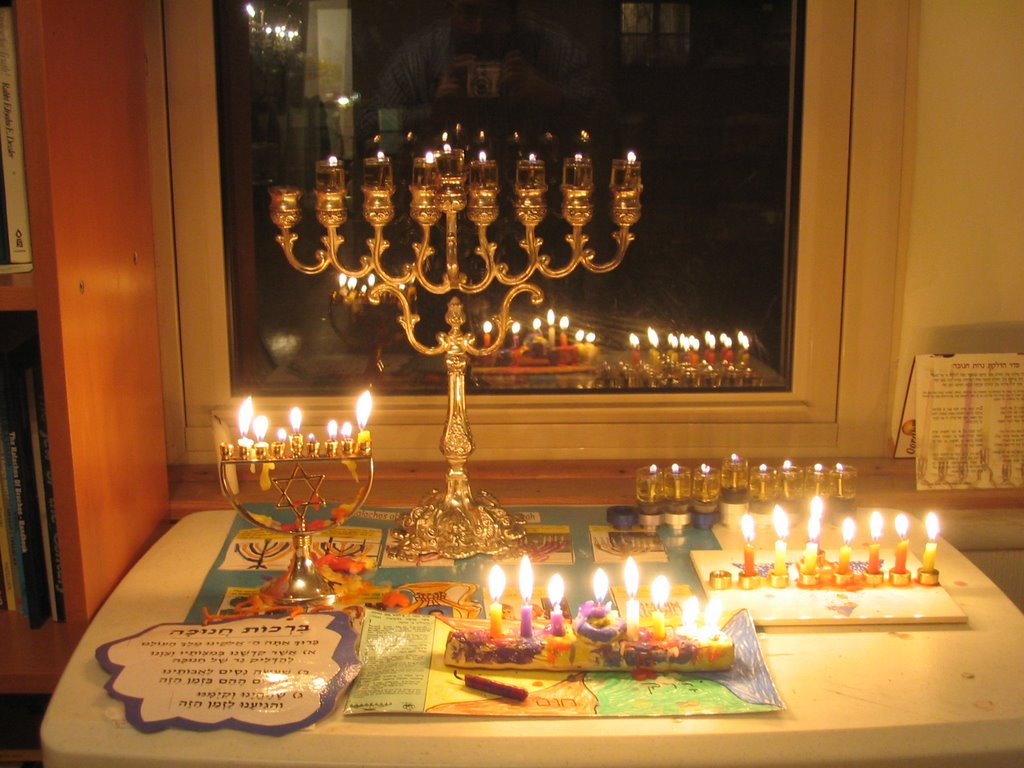
The Menorah in the Window…


I admit, this posting has been sitting in my head for over a week now. I thought it would float away, but it hasn’t.

I find myself constantly seeing menorahs in many different windows.

I actually started seeing them about 3 weeks ago. The first one was in Skokie, IL. The menorah was painted on the window of a pizzeria/sports bar. This menorah was, of course, accompanied by the familiar “Happy Chanuah” painted message, to their Jewish customers. I couldn’t decide if I was supposed to laugh or cry. Then I saw several more in other windows of completely non-kosher eating establishments.

The lighting of the menorah and a ‘traditional’ seder on Pesach are the two most common rituals among our not-yet-observant brothers and sisters. I’ve always thought it ironic that the lighting of the menorah is such a common tradition. The menorah is the symbol of Torah shebal peh, our Oral Law. Our acceptance of this Oral Law is a cornerstone in what helps define the Torah Observant Jew. Yet, it ends on some odd windows. Why?

I think that seeing a menorah painted on a window of “The Villiage Pizzeria” or Burger King does help our brothers and sisters connect with Judaism.
I recently was reading the Sfas Emes and found something amazing. He says that that certain wicks are pasul for use to light neiros on Shabbos, yet acceptable for use on Chanukah. The Sfas Emes says that Chanukah can penetrate a neshama in a way that Shabbos can’t. Chanukah reaches the essence of a yid.
The Thursday before Chanukah I had to go to the post office. The woman at the counter in front of me was having a conversation with the postal officer (who wasn’t going postal). It went like this…
Postal worker: Are you getting ready for the holidays?
Woman: Yeah, Chanukah starts tomorrow night. My boyfriend wants me to light the candles and the whole thing.
Postal worker: That must be nice.
Woman: I guess so. My boyfried isn’t Jewish, so the whole thing is new to him. The truth is that I really don’t want to do it. I haven’t said the blessings in years. I remember my mom mumbling the blessings, but she really didn’t know the words either. I guess I’ll fake it.
Sad, isn’t it? My 4 year old knows the brachos and even what the Greeks did to the Beis Hamikdash (“They put piggies in and stautes”). This grown adult doesn’t even know that much. It’s not her fault. She falls into the category of a Tinuk Shenishba.
I got out of line and ran to my car. I came back into the post office as the woman was leaving and said, “I couldn’t help but overhear your conversation. Would you like this box of candles. The blessings are in English on the back of the box.”
She smiled and said thanks. I don’t always carry extra candles with me (although I have in the past). I actually had just bought them for our kids, but it’s no big deal to give a 19 cent box of candles to another Jew.
I don’t write this to blow my own shofar. I write it make a point. What I did wasn’t special, it’s just my personality.
There are Jews everywhere who just don’t get it. They never had the opportunity to learn what we know. Or the learned it, but it was shoved down their throats and it tasted gross. Every day I daven for an opportunity to be a klei to bring others closer to Hashem. That day, I happened to have my eyes and ears open. It doesn’t always work out, but sometimes it does.
Last Shabbos night my son and I walked to shul the ‘long way’. I wanted to see some of the windows in our neighborhood. Home after home with menorahs in the windows. I said to my son, “I am very happy. Do you know why?”
He answered, “Because we live in Jewish neighborhood, and Baruch Hashem, there are a lot of menorahs around.”
He, of course, was right. Chanukah is almost over, but the reality is that where are always wicks that are waiting to be lit.

The 26th Yartzeit of Rav Hutner zt’l


Today, the 20th of Kislev, is the Yarzeit of Rav Yitzchok Hutner, zt’l. In memory of the former Rosh Yeshiva of Yeshiva Chaim Berlin, there is an excellent article writen in the Yated. Here is an excerpt:
He never forgot the private individual; he gave of his soul to others and not just his time. Once, someone asked him for a decision in a complicated personal matter, and after a long while Rav Hutner told him he still did not have an answer. He explained: “In my Chumash it says, `Love your neighbor as yourself.’ This commandment requires a man to relate to a question from another as if it were his own question, and how he would behave in such a situation. True advice comes only from such empathy. You turned to me in your time of trouble, but it takes time until I can bring myself to live in your situation.”

Once, an avreich came to ask advice for a cure for the despair that bothered him in his avodas Hashem. Rav Hutner explained the difference between pain and despair: “Despair is being tired of living. Become alive and automatically there will be no place for despair! You can either emphasize the recognition of despair, or arouse the vitality that comes from faith in the holiness of a Jew in any situation that might be. If you live with this foundation of faith you will become living person!”

The entire article can be found here.

Over the years as I have met individuals who learned by Rav Hutner I have heard several lesser know stories about him. Here are a few:

On morning Rav Hutner took several of his tamidim from Chaim Berlin in his car (with his driver) for a ride to Prospect Park (Brooklyn) on a crisp October day. They got out of the car and walked to the pond in the middle of the park. Rav Hutner instructed the group of 3 bochrim to look at the lake and pointed out that you could see the bottom of the pond. “This mind of the Chazon Ish is as clear as this lake”, Rav Hutner said. Then they returned to Chaim Berlin.

Before shofar blowing (right before musaf) on Rosh Hashana, Rav Hutner once asked a student in the yeshiva to go check on another student who was in the dorms due to an illness. Of course the student when to check on his ill friend. After davening he returned to let the Rosh Yeshiva know about his sick classmate. As I heard it, the bochur asked Rav Hutner about the halachic problems of missing shofar on Rosh Hashana. Rav Hutner replied, “Do you think that on Rosh Hashana Hashem sees any difference between mitzvos bein adam l’chavero and bein adam l’makom?”

As yeshiva was let out late one afternoon several boys were standing in front of Chaim Berlin as the Rosh Yeshiva and his wife left the building and walked toward their car (which was waiting for them). One boy opened up the front door of the car for Rav Hutner and then opend up the be back door for the Rebbitzen. Rav Hutner looked at the the young man, tapped his cane on the ground (for effect) and said, in perfect Oxford English, “What, pray tell, do you think you are doing?”
The boy replied, “I just wanted to open the car door for the Rosh Yeshiva.”
Rav Hutner then said, “What makes you think that I don’t want to sit with my wife? Remember this: No one or nothing ever comes between a husband and a wife”.

Other postings online

For several months I’ve had the opportunity to have a few things posted on BeyondBT.com.

When they were originally posted, I chose not have links posted on my blog. In an effort to give a clearer view of who I am, I now submit the following links:

PSSD: Post Shavuos Stress Disorder
What’s so important about the number 316?
Family Feud
My Name is Not Neil
Being Thankful for Thankgiving