Check this out and hear messages from many bloggers :The Muqata جميل في المقاطعة: MUQATA PURIM RADIO
MUQATA PURIM RADIO
1 Reply

Check this out and hear messages from many bloggers :The Muqata جميل في المقاطعة: MUQATA PURIM RADIO

The book that I’ve been working on for over a year has been banned by major Orthodox organizations before it has even officially gone to press. After seeking several approbations from respected individuals within the Torah observant community, I have been asked not to proceed with my publication. This will not stop me! Cross-Currents is currenly debating this whole issue and several other bloggers are showing major support for me.
The book, titled YOU DIDN’T HEAR THIS FROM ME, contains inspiring stories about Gadolim, Rabbonim, and present day talmidei chachamim. The unique thing about this book is that it tells the amazing stories of people whose written works have, at one time or another, been banned by the Orthodox community. It also tells the stories behind the banned publications.
That right, finally there is a book about banned books that’s already being banned before it comes out! Included are stores about such giants as the RAMBAM and the RAMCHAL. It also includes more recent stories about indviduals like Rabbi Naftali Zvi Yehuda Berlin (the Netziv), Rabbi Adin Steinsaltz, and Rabbi Noson Slifkin.
As a bonus the book also contains my award winning essay on The Catcher In The Rye, titled “Holden Caulfield- Phoniness, Angst, Rebellon, and other factors that lead to At-Risk-Teens and what we can do to bring them to Teshuva”.
Self-published copies of YOU DIDN’T HEAR THIS FROM ME are currently available for sale on eBay.
Are you tired of actually feeling anything when performing mitzvos?
Are you tired of not looking ‘frum enough’ for your friends, neighbors, or family members?
Do you long to give off the impression of being machmir on everything except menschlikeit?
Don’t you spend too much time thinking about your connection to your creator?
Then maybe you’re ready to try…
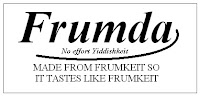
That’s right, it’s Frumda brand sweetener. Created in the Modern Uberdox lab just in time for Purim. It’s made from the finest Frumkeit available and, of course, leave a terrible taste in mouths of those you meet. Just add it your next cup of coffee and you’ll be ready to put absolutely no effort into your Yiddishkeit!!!
Howard Schultz’s “Starbuck memo” finally made the news. It’s really more of a clarion call to get back to basics for the company. Here are several quotes I found interesting:
“Our stores no longer have the soul of the past and reflect a chain of stores vs. the warm feeling of a neighborhood store.”
“Some people even call our stores sterile, cookie cutter, no longer reflecting the passion our partners feel about our coffee. In fact, I am not sure people today even know we are roasting coffee.”
“We achieved fresh roasted bagged coffee, but at what cost? The loss of aroma – perhaps the most powerful non-verbal signal we had in our stores; the loss of our people scooping fresh coffee from the bins and grinding it fresh in front of the customer, and once again stripping the store of tradition and our heritage?”
“I take full responsibility myself, but we desperately need to look into the mirror and realize it’s time to get back to the core and make the changes necessary to evoke the heritage, the tradition and the passion that we all have for the true Starbucks experience,” he said.
“The merchandise, more art than science, is far removed from being the merchant that I believe we can be and certainly at a minimum should support the foundation of our coffee heritage. Some stores don’t have coffee grinders, French presses from Bodum, or even coffee filters.”
“I have said for 20 years that our success is not an entitlement and now it’s proving to be a reality. Let’s be smarter about how we are spending our time, money and resources. Let’s get back to the core. Push for innovation and do the things necessary to once again differentiate Starbucks from all others.”
At times I can see how my own Torah observance as become similar to the current ‘Starbucks experience’. I often wonder if I have become victim of ‘cookie-cutter chain-store’ Yiddishkeit?Has the ‘merchandise’ of my observance become more important that actual mitzvah observance? Has my personality been brushed aside to fit into a certain mold?
“Back to the core” is a phrase that Schultz uses twice. I his message to timely, as on Purim we also get “back to the core” as manifested in our reacceptance of the Torah.
We all come up with costumes for our kids and ourselves. Is more effort put into hiding who we are than revealing what is truly inside us?
As I look at the four mitzvos of Purim I realized they hint to some of the basics of Torah Judaism.
Hearing the reading of the Book of Esther: Not only listen, but understand what it says
Giving monetary gifts to the poor: Do a chessed for someone who needs it
Giving two prepared food gifts to at least one other person: Reach out for the sake of reaching out
Eating a festive Purim meal: Let your soul and body serve Hashem with joy.
I’ve always found in interesting that one can fullfill the mitzvah of shaloch manos with two different types of food that fall under the same bracha (like a can of Coke and some prepared salmon). From a bracha point a view the foods are the same, yet have very different characteristics. Each person is also, on the surface, similar, yet we each have different personalities.
As I experience Purim this year I’m looking forward to getting back to my core! Have a safe and Freilichen Purim and may we see our galus end today!
Howard Schultz’s memo can be read here.
Another good read is a recent posting by A Simple Jew titled Doing What We Do Best.
_________________________
Added parsha bonus:
This weeks’ parsha deals with the bedgai kenuna and specifically the extra four accessories worn by the Kohen Gadol. Sefer HaChinuch (mitzvah 99) states that the Kohen Gadol would only wear his garments on Yom Kippur. It was then put away and the following year he wore a new one. I believe the reasoning behind this was so he would become desensitzed to the importance of wearing the clothing of the Kohen Gadol.
We all have some favorite piece of clothing. It could be a sweater, shirt, or a pair of shoes. Imagine how we’d feel if we could only wear it once a year?
Mitzvos are often referred as ‘clothing for the neshama’. I use this lesson from the Chinuch to try to have a feeling of newness to those mitzvos that I perform everyday. It’s not easy, and most of the time I fall short of my goal, but I attempt. Gut Shabbos Kodesh
Click here to find out!
As a parent I wonder how my children behave when I’m not around. We all hope that our kids learn positive things at home and in school and apply the lessons in everyday life.
My wife was recently told the following story about our first grader.
My son’s gym class was having a unit on rollerskating. The mother of one of the kids’ was helping out the gym teacher one day and told my wife that she’s so happy her son has a friend like our son.
It seems that her son has having a little trouble getting comfortable on rollerskates. She observed my son whizzing by on his rollerblades. She saw my son pass her child, as her son fell, and my son circled around to see if he was alright.
This mother then told my wife that she saw my son purposely fall down and say to her son, “See, everyone falls down. It’s no big deal”. My son helped his friend up and they continued on.
I am thankful to have experienced true nachas ruach!
 (Screenshot from Star Wars: Battlefront for PC)
 (I hope someone gets this posting title)
Gut Chodesh. I usually have to remind myself that happiness should be a given. Adar just happens to be a month when it’s easier to receive the natural simcha that is available to me all the time.
Rabbi Akiva Tatz defines happiness as the natural expression of your neshama doing what its’ created to do. I don’t let myself have fun enough. I often let most aspects of my life become way too serious. I hope to work on this during Chodesh Adar and loosen up a bit.
Here’s a small list off the top of my head of things that happened during the past 36 hours that made me happy:
My kids being themselves and showing their personality
My wife laughing
My 4 yr old uberdaughter who lastnight started singing along to Hafachta
My 7 yr old uberson wanting to share something he learned on the parsha
My wife being happy soley because I am happy
When I read that Rav Nosson Tzvi Finkel zt’l, the Alter of Slabodka, would say that “he did not have a Yeshiva-one unit of hundreds of students, but rather he had hundreds of individuals.”
Being around good friends
Seeing our 4 month old smile for no reason what so ever
Eating my wife’s grilled chicken Caesar salad
Rav Hirsch writes in THE NINETEEN LETTERS that, “Happiness decreeded in accordance with compulsory, external standards ceases to be happiness.” (Second Letter)
What make you happy?
It is cold. this past Shabbos (and most of this week so far) is the coldest weather I have ever experienced. I was cold like this once before, back in the winter of 1984. I attended an NCSY shabbaton that was, for some reason, held on a camp ground in Eureka, MO. I only remember two things from that Shabbos: freezing and meeting Lenny Solomon. Anyway, back to the post…
This is how my mind works most of the time:
As I walked out the door Shabbos morning to go to shul I carried my 8 oz cup of hot coffee. It stayed hot for about a minute and a half, then became Iced Coffee. As I finished it and threw the cup in the garbage I thought about how funny it is that an 8 oz cup of coffee (literally a ‘cup’) is really not the standard size for a cup of coffee today. All thanks to Starbucks. Prior to 1997 there were only three cups sizes you could buy coffee at a Starbucks:
Short (8oz)
Tall (12oz)
Grande (16oz)
Then it was decided by the powers that we were not drinking enough coffee. The ‘short’ size was eliminated and the ‘Venti’ size (20oz) was added to their menu. Short be came obsolete and was replaced by the now industry standard of a 12 oz cup (‘Tall’ in Starbucks-speak).
As I continued my walk to shul, I thought about paradigm shifts and how our values, standards, and goals can change with a thought, something our spouse or children say to us, or something we read. I then remembered one of my favorite stories.
The story below, from Am Echad Resources, was written by Howard Schultz (chairman and chief global strategist of Starbucks). This article is excerpted from a speech he delivered, and is reprinted courtesy of Hermes Magazine, Fall 2001, a publication of Columbia Business School.
From AM ECHAD RESOURCES:
When I was in Israel, I went to Mea Shearim, the ultra-Orthodox area within Jerusalem. Along with a group of businessmen I was with, I had the opportunity to have an audience with Rabbi Noson Tzvi Finkel, the head of a yeshiva there [Mir Yeshiva]. I had never heard of him and didn’t know anything about him. We went into his study and waited 10 to 15 minutes for him. Finally, the doors opened.
What we did not know was that Rabbi Finkel was severely afflicted with Parkinson’s disease. He sat down at the head of the table, and, naturally, our inclination was to look away. We didn’t want to embarrass him.
We were all looking away, and we heard this big bang on the table: “Gentlemen, look at me, and look at me right now.” Now his speech affliction was worse than his physical shaking. It was really hard to listen to him and watch him. He said, “I have only a few minutes for you because I know you’re all busy American businessmen.” You know, just a little dig there.
Then he asked, “Who can tell me what the lesson of the Holocaust is?” He called on one guy, who didn’t know what to do — it was like being called on in the fifth grade without the answer. And the guy says something benign like, “We will never, ever forget?” And the rabbi completely dismisses him. I felt terrible for the guy until I realized the rabbi was getting ready to call on someone else. All of us were sort of under the table, looking away — you know, please, not me. He did not call me. I was sweating. He called on another guy, who had such a fantastic answer: “We will never, ever again be a victim or bystander.”
The rabbi said, “You guys just don’t get it. Okay, gentlemen, let me tell you the essence of the human spirit.
“As you know, during the Holocaust, the people were transported in the worst possible, inhumane way by railcar. They thought they were going to a work camp. We all know they were going to a death camp.
“After hours and hours in this inhumane corral with no light, no bathroom, cold, they arrived at the camps. The doors were swung wide open, and they were blinded by the light. Men were separated from women, mothers from daughters, fathers from sons. They went off to the bunkers to sleep.
“As they went into the area to sleep, only one person was given a blanket for every six. The person who received the blanket, when he went to bed, had to decide, ‘Am I going to push the blanket to the five other people who did not get one, or am I going to pull it toward myself to stay warm?'”
And Rabbi Finkel says, “It was during this defining moment that we learned the power of the human spirit, because we pushed the blanket to five others.”
And with that, he stood up and said, “Take your blanket. Take it back to America and push it to five other people.”
I made it to shul and forgot about being cold. I remembered the blanket and for the past four days have been opening my eyes to chessed oportunites.
The following conversation occurred a few days ago as I drove my 4 yrs old daughters’ carpool home from school. We had just dropped off our first passenger and were in route to drop off the second one when my daughter said…
Uberdaughter: Abba, (name withheld) left something in the car. We have to give it to her, it’s a mitzvah.
Me: That’s right, Uberdaughter. It’s the mitzvah of Hashovas Avedah, giving something back to someone who lost something. We’ll have to write you a ‘mitzvah note’ for school.
2nd Child/Passenger (soon to be dropped off): I get a ‘mitzvah note’, too.
Me: O.K., you can tell your mom when I take you home.
Uberdaughter: Oh no!! I get the mitzvah note, because I saw that (name withheld) left something. The person who sees a mitzvah and yells about it is the one who did the mitzvah for real-life and gets the mitzvah. Hashem says so.
All right, while my daughter did use some ‘hashkafic literary license’, what she said holds some truth. It actually reminded me of a great story published in the book Gut Voch, by Avrohom Barash.
The story, from page 68, titled “Everything Counts” follows:
The sister of the Vilna Gaon would often collect tzedakah for various charitable causes together with a friend. At one point the two agreed that whichever one of them would pass away first would come to the other one in a dream and relate her experiences.
When one of them left this world, she kept her word and appeared to her friend. “Tell me,” she asked, “what is it like in Gan Eden?”
“I am not prepared to tell you everything,” she replied. “But one thing I can say: everything is calculated minutely. Do you remember that one day when we were collecting for an important cause and you saw a woman across the road whom we could approach? You raised your hand and pointed her out, and I crossed the road and spoke to her. You will receeive reward for lifting your finger to point her out, while I was rewarded for having taken the trouble to cross the road and go over to her.”
My daughter was on target.
